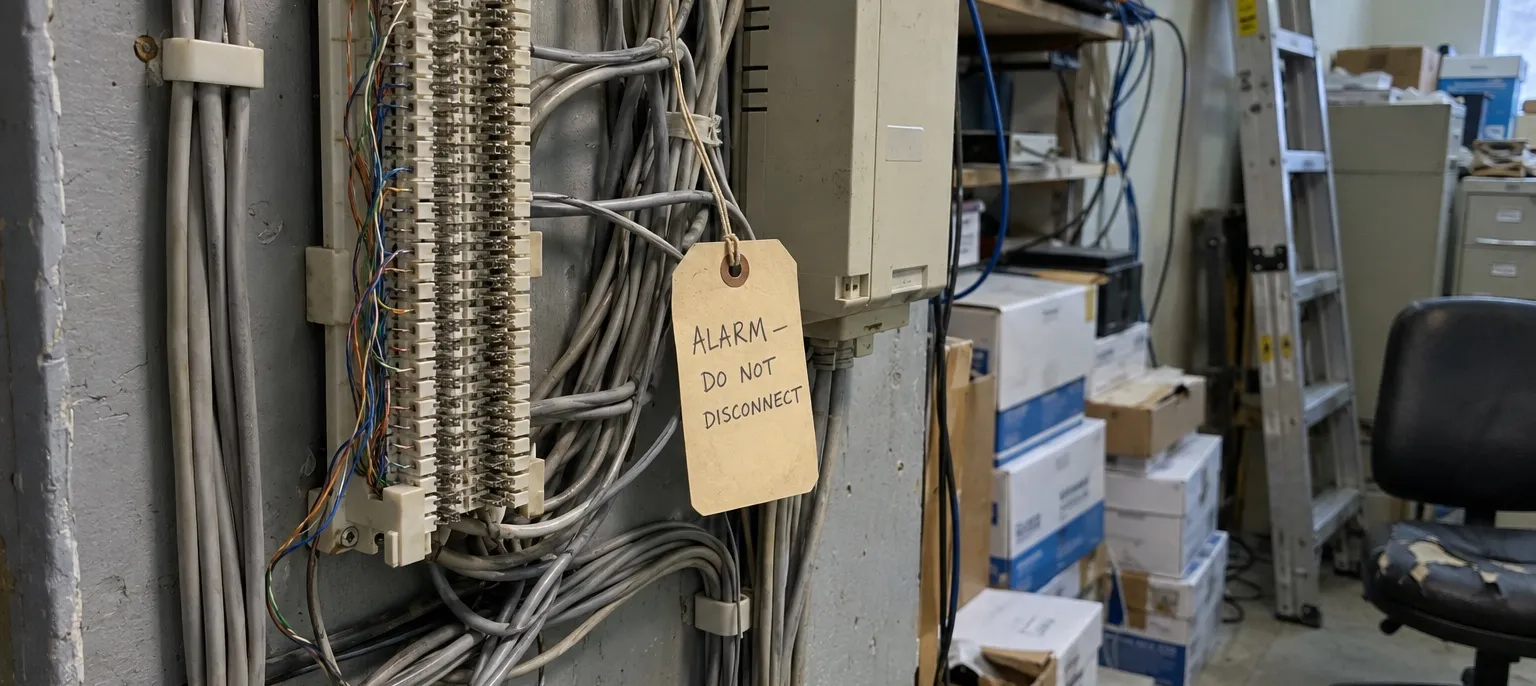
When a client sends us their phone bill, we go through every line on it and figure out what each one is doing. The copper line that’s still plugged into the fire panel usually isn’t on that bill. Most of the time it’s on a different bill that never gets sent to us.
If you got a letter from AT&T, Verizon, or CenturyLink about changes to your service, it’s almost certainly about POTS lines, short for plain old telephone service: the copper landlines carriers are retiring. As of early October, AT&T has FCC approval to stop providing copper phone service to about 90,000 customers in 18 states, starting as early as November 15, 2026.1 Verizon has filed to do the same at about 750,000 locations in nine states and DC starting November 30, though that one is still waiting on approval. Its filing says that’s 2.7% of the homes and businesses it could serve there.2 CenturyLink filed on September 30 to end copper voice in parts of 24 Florida cities, also starting November 30.3
Why Your Phones Are Probably Not the Problem
We can’t remember the last time we found a copper line still carrying phone calls for a business. If a phone system isn’t VoIP already, it’s almost always running on a PRI, a digital circuit built for a phone system rather than a bundle of individual copper lines. If you have one, your bill lists it as a PRI.
The copper that’s left tends to be plugged into something other than a phone: an alarm panel, a fire panel, an elevator.
How to Find Every Copper Line You Pay For
- Pull every phone bill your business pays, including bills from a different phone company than the one your business lines are on. Alarm and elevator lines often sit on their own account.
- List every phone number on every bill, including the ones nobody recognizes.
- Match each number to what it’s plugged into. For any line that might run the alarm, the fire panel, or the elevator, ask the company that services that equipment.
- Decide who replaces each one.
| Line | Who replaces it | What it usually moves to | What to do |
|---|---|---|---|
| Phone lines and PRIs | Your phone provider | Hosted VoIP, with your numbers ported | Send us the bill |
| Fax | Your phone provider | Cloud fax, or an adapter for a physical machine | Send us the bill |
| Fire alarm panel | Your alarm company, with the fire marshal’s approval | A cellular or radio communicator, which current fire codes allow4 | Ask what they’ll replace the line with and whether the fire marshal has signed off |
| Security alarm | Your alarm company | A cellular or IP communicator | Ask whether your panel still runs on a phone line |
| Elevator emergency phone | Your elevator company | Whatever your local code allows for that elevator | Ask what your elevator needs under your local code |
| Card terminals, postage meters, door phones | Usually nobody | Most already run over the internet | Check each one anyway |
Send us the bills and we’ll sort out the phone and fax lines. It’s not unusual to find a copper line still wired into an alarm or fire panel. When we do, we tell you it’s there and that you need to keep it until that vendor replaces it.
Phone Lines and PRIs
This is the part we replace. Your numbers port to the new system, your old phones keep working until the new ones are set up and tested, and you switch over on a date we coordinate with you. A typical rollout takes about three weeks.
If you’re on a PRI, the November deadlines don’t apply to you, because none of those filings covers PRIs. They’re aging too, though. Verizon filed in June 2026 to discontinue some of its PRI and T1 service nationwide,5 and AT&T has stopped taking new PRI orders in some areas.6 Replacing a PRI is the same project as replacing copper phone lines, and the switching guide walks through it.
Fax Lines
We prefer cloud fax: faxes arrive in email, and you send them from your computer.
If you have a reason to keep a physical fax machine, we connect it with an analog telephone adapter (ATA). Fax machines were designed for copper lines and don’t handle the delays and lost packets of an internet connection well, which is why we set up the ATA specifically for fax.
Fax isn’t included in the $24.95 per user.7 We bill fax lines separately. Cloud fax starts at $10.50 a month, including the fax number, and the price depends on your setup, and sometimes on how much you fax.
Fire Alarm, Security, and Elevator Lines
We don’t replace these. It’s a safety issue, and it needs to be handled by the people who install and support the safety equipment.
Don’t expect the carrier to sort this out for you. When the FCC rewrote its rules for these shutoffs in March 2026, the alarm industry asked it to require carriers to offer replacements that work with alarm equipment. The FCC declined and only encouraged carriers to avoid breaking alarm signaling.8
Some carriers and equipment vendors sell boxes that keep an analog line working over cellular. We don’t sell them. If your alarm or elevator vendor wants one, they’ll supply it or tell you which one to buy.
Cancelling the Old Lines
We don’t cancel your copper lines. We tell you which lines you have and what each one was doing, and you cancel them with the carrier. That’s on purpose: if a line turns out to run your fire panel, you want to decide when it goes, after your alarm company has moved it.
Once your numbers have ported and the alarm and elevator lines are handled, cancel the rest.
Questions We Get About Copper Lines
Will you replace the phone line for our fire alarm or elevator?
Is fax included in the $24.95 per user?
How much warning will our carrier give us before it shuts off copper?
Do you cancel our old copper lines after we switch?
We already have VoIP. Does any of this apply to us?
Got a carrier letter, or a pile of bills you can’t make sense of?
Send us every phone bill you pay. That’s how we build an accurate quote, and we’ll tell you which lines we’d replace and which ones another vendor has to replace.
Get Your Quote → or call 844-767-1924
Footnotes
-
AT&T, Section 63.71 application, WC Docket No. 25-335, filed December 1, 2025, covering Alabama, Arkansas, Florida, Georgia, Indiana, Kansas, Kentucky, Louisiana, Michigan, Mississippi, Missouri, North Carolina, Ohio, Oklahoma, South Carolina, Tennessee, Texas, and Wisconsin; FCC Public Notice DA 25-1043, December 12, 2025. Application · FCC notice ↩
-
Verizon, Section 63.71 application, WC Docket No. 26-252, filed September 9, 2026. A separate Verizon request covering nine other states (WC Docket No. 26-227) was removed from automatic grant by the FCC on September 25, 2026. Application · FCC DA 26-1038 ↩
-
CenturyLink of Florida and CenturyLink of Nevada, discontinuance application, WC Docket No. 26-285, filed September 30, 2026. Application ↩
-
NFPA 72, National Fire Alarm and Signaling Code, 2010 edition and later; summarized by the Town of Brighton, NY Fire Marshal. Brighton Fire Marshal ↩
-
Verizon (MCI and MCImetro entities), Section 63.71 application to discontinue ISDN PRI, Full T1 Service, Digital PBX Trunks, and Virtual Foreign Exchange, notice dated June 2026; Florida PSC courtesy copy filed June 23, 2026. Filing ↩
-
AT&T, Discontinued Legacy Service Log, September 4, 2026. Log ↩
-
$24.95 per user per month. Applicable taxes and FCC regulatory fees are additional. ↩
-
FCC, Network and Services Modernization Report and Order, FCC 26-19, adopted March 26, 2026. Order ↩